USD
USD
How to replace linear guide rail on cnc machine?
Video on Youtube
Maintenance personnel completed the replacement of the second linear guide rail on the Mazak lathe, noting several key installation points; subsequently, damage to the X-axis auxiliary rail slide block was discovered, requiring spare parts for repair.
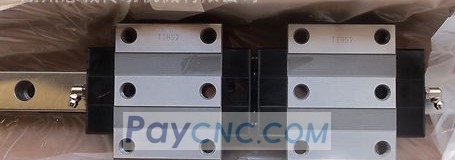
During the removal of the old rail, the casting was positioned appropriately; slide block mounting screws were removed, the casting was jacked up to extract the slide block, and the screws at both ends of the linear rail were removed. Due to the strong adhesion between the linear rail and the casting, significant force was required to extract the auxiliary rail diagonally through the gap between the casting and the tailstock.
Extracting the slide block for inspection is prohibited, as the internal rollers are liable to scatter.
After cleaning the contact surfaces, two technicians worked together to insert the linear rail sideways through the gap, avoiding collisions. Screws were initially placed against the rail without tightening; after installing the gib strip, a torque wrench was used to tighten fasteners in the sequence of gib strip first, then linear rail, to prevent irreversible deformation of the rail.
Post-tightening inspections showed linear parallelism and flatness accuracies of 5μm, 7μm, and 5μm. Bolt caps were installed flush using a nylon mallet; the ball screw nut connection was cleaned, the lubrication line was connected, and shims (uniform thickness, notches facing down) were installed. Slide block screws were tightened in a diagonal pattern. After homing the Z-axis, a turret deviation of 0.10 mm (10 "sī") was detected, confirming a previous error in Z-axis adjustment.
Handling of unexpected failure: While preparing to adjust the X-axis, the X-axis auxiliary rail slide block was found to be shattered with rollers dislodged; the turret disk requires removal and disassembly for repair. The customer has been notified, and the process is awaiting spare parts.
Maintenance personnel completed the replacement of the second linear guide rail on the Mazak lathe, noting several key installation points; subsequently, damage to the X-axis auxiliary rail slide block was discovered, requiring spare parts for repair.
During the removal of the old rail, the casting was positioned appropriately; slide block mounting screws were removed, the casting was jacked up to extract the slide block, and the screws at both ends of the linear rail were removed. Due to the strong adhesion between the linear rail and the casting, significant force was required to extract the auxiliary rail diagonally through the gap between the casting and the tailstock.
Extracting the slide block for inspection is prohibited, as the internal rollers are liable to scatter.
After cleaning the contact surfaces, two technicians worked together to insert the linear rail sideways through the gap, avoiding collisions. Screws were initially placed against the rail without tightening; after installing the gib strip, a torque wrench was used to tighten fasteners in the sequence of gib strip first, then linear rail, to prevent irreversible deformation of the rail.
Post-tightening inspections showed linear parallelism and flatness accuracies of 5μm, 7μm, and 5μm. Bolt caps were installed flush using a nylon mallet; the ball screw nut connection was cleaned, the lubrication line was connected, and shims (uniform thickness, notches facing down) were installed. Slide block screws were tightened in a diagonal pattern. After homing the Z-axis, a turret deviation of 0.10 mm (10 "sī") was detected, confirming a previous error in Z-axis adjustment.
Handling of unexpected failure: While preparing to adjust the X-axis, the X-axis auxiliary rail slide block was found to be shattered with rollers dislodged; the turret disk requires removal and disassembly for repair. The customer has been notified, and the process is awaiting spare parts.